
The History of the Hobby Horse
The earliest written description (1830):
“A number of young men, mostly fishermen and sailors, having previously made some grotesque figures of light stuff, rudely resembling men, and horses with long tails, sufficiently large to cover and disguise the persons who are to carry them, assemble together and perambulate the town and neighbourhood, performing a variety of antics, to the great amusement of the children and young persons:
they never fail to pay a visit to Dunster Castle, where, after having been hospitably regaled with strong beer and victuals, they always receive a present in money; many other persons, inhabitants of the places they visit, give them small sums, and such persons as they meet are also asked to contribute a trifle;
if they are refused, the person of the refuser is subjected to the ceremony of booting or pursing; this is done by some of the attendants holding his person while one of the figures inflict ten slight blows on him with the top of a boot; he is then liberated and all parties give three huzzas: the most trifling sum buys off this ceremony, and it is seldom or never performed but on those who purposely throw themselves in their way and join the party, or obstruct them in their vagaries.
This custom has prevailed for ages, but what gave rise to it is at present unknown: it probably owes its origin to some ancient custom of perambulating the boundaries of the parish.”
Anyone for a Danish?
Perambulating
the boundaries is all very well but it is well known in
Minehead that, long before our Victorian visitor, the Danes 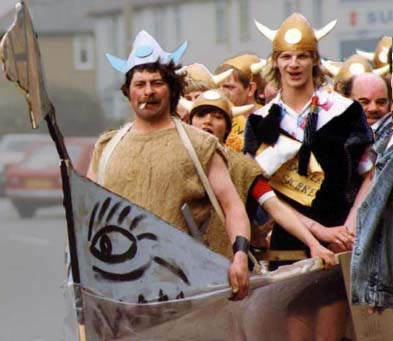 came
sailing up the coast intent on landing and doing a spot of collecting
for deserving seafarers (themselves). The people of Minehead sent the
Hobby Horse to the shore, to prance and cavort in a menacing manner,
which so startled the marauders that they decided that Watchet might
be a bit more welcoming and generous with their loose change.
(for proof see [1] below)
came
sailing up the coast intent on landing and doing a spot of collecting
for deserving seafarers (themselves). The people of Minehead sent the
Hobby Horse to the shore, to prance and cavort in a menacing manner,
which so startled the marauders that they decided that Watchet might
be a bit more welcoming and generous with their loose change.
(for proof see [1] below)
Whatever
the truth - and old oral traditions contain more wisdom that we
sometimes credit them with – the Hobby Horse is definitely
traceable back at least to 1792, where it was recorded in the ledger
at Dunster Castle . 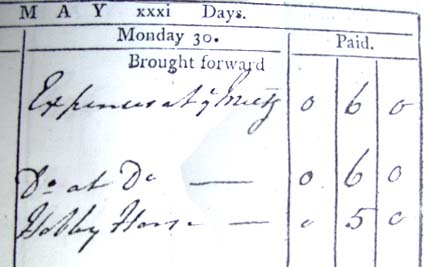 It
is reasonable to suppose that it was well established. After all it
was invited up to dance for the lord and lady and to be paid five
shillings - nearly a week's wages [2] - for the
show, so who knows how old it really is and where it came from?
It
is reasonable to suppose that it was well established. After all it
was invited up to dance for the lord and lady and to be paid five
shillings - nearly a week's wages [2] - for the
show, so who knows how old it really is and where it came from?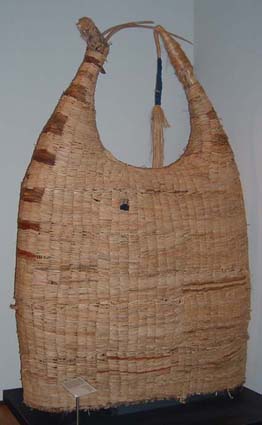
Some people think that it may have been brought back from Africa by Minehead seafarers and elsewhere on this site you will find African masks and customs which bear remarkable similarities.
 Others
think that it is part of an ancient worldwide tradition of disguise
that goes back at least 12000 years to Paleolithic times when people
were recorded in cave paintings as dressing up as animals.
Others
think that it is part of an ancient worldwide tradition of disguise
that goes back at least 12000 years to Paleolithic times when people
were recorded in cave paintings as dressing up as animals.
 If
you do a search you will probably find websites that claim it's a
pagan fertility rite. They're barking mad, of course. [3]
If
you do a search you will probably find websites that claim it's a
pagan fertility rite. They're barking mad, of course. [3]
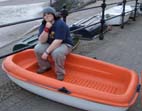 Still
others think it’s
not a horse at all, but an upturned boat.
Still
others think it’s
not a horse at all, but an upturned boat.
But here in Minehead we aren’t going to lose much sleep over any of that. As far as we are concerned The Original Sailors Horse is the direct descendant of that old Hobby Horse that fought off the Danish invaders. And until anyone with a time machine can prove us wrong, that’s the way it will have to stay in the Third Millennium, just as it was in the First.
And to prove that some things never change we'll still have some money off you for deserving local seafarers.

(We are licenced to collect for the RNLI)
Sources:
[1] - The descendants of Eye witnesses
[2] - in 1792 the average wage in the Minehead area was 6/-, nowadays (2006) it's about £400, so they did pretty well out of it. 1792 - Eden, Sir Frederick Morton "The State of the Poor: or a history of the labouring classes in England.." 1797;
[3] - 2006 - Various Internet sources